NFPA 704 Diamond Generator
Set the four quadrants and get a correctly proportioned fire diamond you can print or download as an SVG. Each rating shows what it means as you pick it, so you can sanity check a number before it goes on a door.
Look Up a Chemical
Type a chemical and the quadrants fill from its published NFPA rating. 627 chemicals, sourced from NOAA CAMEO Chemicals, which is a US Government product in the public domain.
Build the Diamond
How to Read It
What each quadrant is for
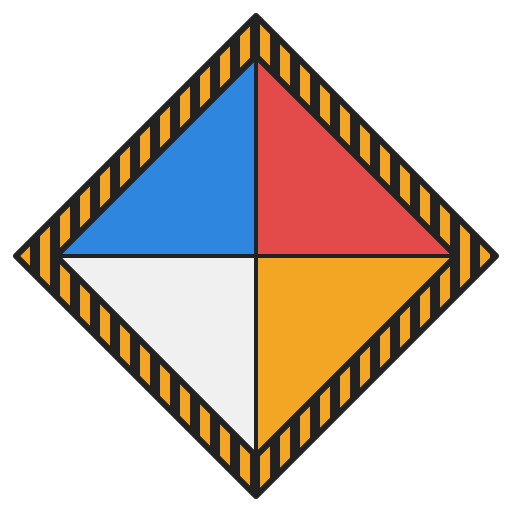
The diamond is turned on point. Blue on the left is the health hazard, red on top is flammability, yellow on the right is instability or reactivity, and white at the bottom carries special notices rather than a number.
Blue, red and yellow are rated 0 through 4. Zero means no special hazard beyond that of ordinary combustible material. Four is the most severe. The scale is about the degree of hazard to emergency responders during a short, intense exposure, which is why it does not line up with chronic health measures like a permissible exposure limit.
NFPA 704 is not a DOT placard
These get mixed up constantly. NFPA 704 is a fixed facility marking. Its job is to tell a responder arriving at a building, tank or storage room what they are walking into.
DOT placards under 49 CFR part 172 subpart F mark hazardous materials in transport, and they are driven by hazard class and quantity, not by a 0 to 4 rating. A drum going on a truck needs the DOT marking and labels, not a fire diamond.
If you need the transport side, use the DOT Placard Calculator or the UN Number Lookup.
When is a diamond actually required?
NFPA 704 is a consensus standard, not a federal regulation. It becomes enforceable where a state or local fire code adopts it, which many jurisdictions do by adopting the International Fire Code or a similar model code. Whether you must post one, how large it must be, and where it goes on the building are all questions for the fire code official with jurisdiction over your site.
Separately, OSHA hazard communication at 29 CFR 1910.1200 requires labels on containers in the workplace, but that is the GHS label system with its own pictograms, not NFPA 704. Meeting one does not satisfy the other.
Where the lookup ratings come from
627 chemicals, read off NOAA CAMEO Chemicals datasheets. CAMEO is a US Government product and its content is in the public domain, which is why these can be published here. The NFPA 704 classification criteria themselves belong to NFPA and are not reproduced.
Every result names the CAMEO datasheet it came from, because a CAS search can land on a broader sheet than you expect. Searching p-xylene resolves to CAMEO's mixed isomers entry, and you should see that rather than have it hidden.
Multi-substance mixture datasheets were excluded. A CAS lookup for sulfuric acid returns CAMEO's hydrofluoric and sulfuric acid mixture sheet, whose ratings do not describe sulfuric acid on its own. Rather than show a plausible wrong answer, those 13 entries were left out and the tool asks you to enter the rating yourself.
None of this replaces the SDS. A rating applies to a formulation, and yours may differ from the pure substance.
Further reading: Reading an NFPA 704 diamond, and why it is not a DOT placard.