
Industrial Tank Cleaning: Confined Space Entry, Sludge Removal, and Recommissioning
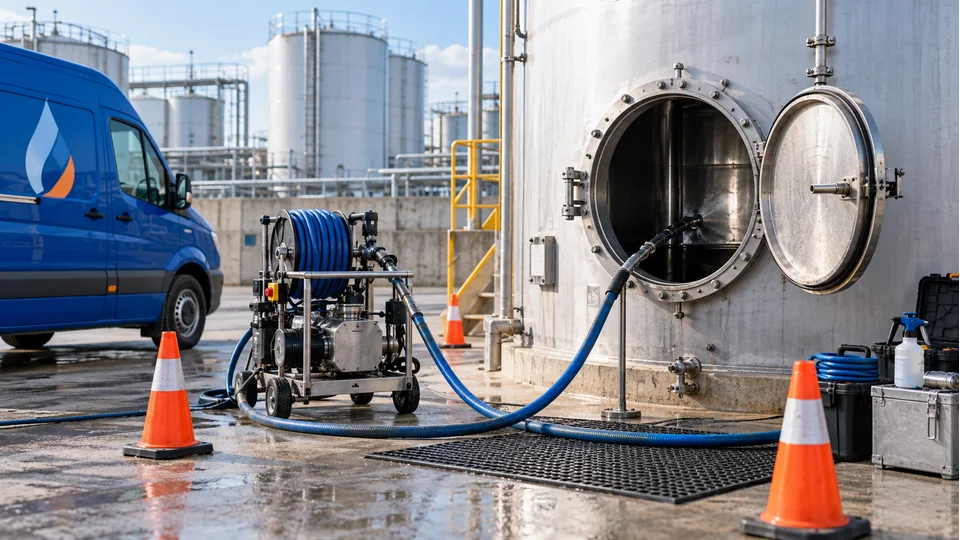
Tank cleaning is the work nobody wants to do but everyone needs done. Sludge accumulates. Product changes require contamination removal. Inspection schedules force interior access. Decommissioning requires the tank to be empty, vapor-free, and certified clean before it can be moved or scrapped. None of this work is glamorous, but all of it is necessary, and most of it requires confined space entry under conditions that make it some of the most hazardous work in the industry.
Industrial tank cleaning services cover the cleaning of aboveground storage tanks (ASTs), underground storage tanks (USTs), frac tanks, process vessels, mixing tanks, rail cars, and any other bulk storage container. The work involves degassing, sludge removal, surface cleaning, waste characterization, and disposal of the recovered material. Pricing varies by tank size, product type, and how clean the tank needs to be when the work is done.
When You Need Tank Cleaning
Scheduled inspection prep is the most common reason. API 653 inspections of aboveground storage tanks require interior access on a defined schedule, typically every 10 to 20 years depending on tank service. STI SP001 inspections of shop-built ASTs follow similar cycles. Underground storage tanks require periodic internal inspections under state-specific UST programs. The tank must be cleaned to bare metal before the inspector can do their work.
Product changes require thorough cleaning to prevent cross-contamination. Switching a tank from gasoline to diesel, from one chemical product to another, or from any product to a higher-purity grade requires removing all residual material from the previous service. Even small amounts of cross-contamination can ruin a load.
Sludge accumulation reduces working capacity and contaminates clean product. Heavy oils, asphalt, crude oil, and many process chemicals accumulate sludge over time. Tanks holding No. 6 fuel oil or asphalt may need cleaning every 2 to 5 years to maintain capacity.
Decommissioning and removal require the tank to be empty, vapor-free, and certified clean before it can be cut up for scrap or moved off site. UST closure under 40 CFR 280.71 specifically requires removal of all liquids and accumulated sludges before the tank is removed.
After a release event when product has contaminated the inside of secondary containment, dike walls, or the exterior of nearby tanks. The cleanup may include both the tank that released and any neighboring equipment that was affected.
The Phases of a Tank Cleaning Project
Phase 1: Planning and characterization. Before any work starts, the contractor needs to know what's in the tank, how much is in it, what condition the tank is in, and what the cleaned-out condition needs to be. A site visit, review of tank records, and waste characterization sampling all happen before the work order is finalized. For larger projects, a site-specific health and safety plan (HASP) is required.
Phase 2: Product removal and recovery. Most tanks have usable product remaining at the time cleaning is scheduled. The first step is recovering as much product as possible for reuse or off-spec sale. This is typically done with vacuum trucks, pumps, or both, depending on product viscosity. Recovered product may be returned to the customer's process, sold to a fuel blender, or shipped for disposal as hazardous waste.
Phase 3: Vapor removal (degassing). Tanks that held flammable or toxic materials must be made vapor-free before any entry. Degassing involves displacing the vapor space with air or inert gas while monitoring for combustible vapors and toxic gases. Vapor recovery and treatment may be required to comply with air permits, especially for VOC-heavy products. Atmosphere monitoring continues throughout the entire job.
Phase 4: Sludge and residue removal. The bottom sludge is the hardest part of any tank cleaning. Heavy sludge may require manual shoveling, robotic sludge removal equipment, or hot water and chemical wash to mobilize. Sludge characterization determines whether it goes to a fuel blender (for petroleum sludges with heating value), a cement kiln (for inorganic-contaminated sludges), or a Subtitle C landfill (for the worst cases).
Phase 5: Final cleaning and certification. After bulk sludge removal, the tank interior is wash-cleaned to the specified standard. For inspection prep this means bare metal everywhere the inspector needs to see. For product change this means residue levels below a defined threshold. For decommissioning this means certified vapor-free and free of accumulated residues. The certification depends on the next intended use of the tank.
Confined Space Entry Requirements
Most tank interiors are permit-required confined spaces under OSHA 29 CFR 1910.146. This triggers a specific set of requirements that any contractor doing this work must follow. If a contractor is willing to send people into a tank without these procedures, do not hire them.
Atmosphere testing happens before entry and continuously during entry. Oxygen content must be 19.5% to 23.5%. LEL (lower explosive limit) must be below 10% (some employers use a stricter 5% limit). Toxic gases must be below their permissible exposure limits. The atmosphere is tested at multiple levels in the tank because gases stratify by density.
Ventilation is provided continuously during entry. Forced air ventilation displaces residual vapors and dilutes any vapors generated by cleaning activities. Ventilation rates depend on tank size and the nature of the residual material. Hot work (cutting, welding) inside a tank requires additional ventilation and atmosphere monitoring beyond cold cleaning work.
Attendant and entry supervisor roles are required. The attendant stays outside the tank, maintains continuous communication with entrants, monitors conditions, and is the only person who can authorize evacuation. The entry supervisor signs the entry permit and verifies all preconditions before entry. These cannot be the same person, and neither can be doing other work during the entry.
Rescue plan must be in place before entry begins. The rescue plan identifies who will perform rescue, what equipment is available, and how emergency services will be summoned. For most tank entries, this means a trained rescue team on standby with retrieval equipment, harnesses, and SCBA. Calling 911 is not a rescue plan.
Personal protective equipment includes Tyvek or similar chemical-resistant suits, supplied-air respirators (SCBA or airline systems with escape bottles), gloves matched to the residue, and appropriate boots. PPE selection depends on what's in the tank and what work is being performed.
Tank Types and Their Specific Challenges
Aboveground storage tanks (ASTs) are the most common type cleaned. They range from a few hundred gallons (small farm tanks) to millions of gallons (refinery storage). Larger ASTs may have floating roofs, internal heaters, or mixing systems that complicate the cleaning approach. Manway access is usually adequate but some older tanks have limited entry points.
Underground storage tanks (USTs) add the challenge of working in a confined area with limited natural ventilation. Most USTs are accessed only through small vapor recovery or inspection ports, requiring specialized equipment for cleaning. UST cleaning is often combined with closure work since access is so difficult.
Frac tanks (mobile bulk storage) typically hold 18,000 to 21,000 gallons and are used for temporary storage at construction, drilling, and remediation sites. They are cleaned between jobs to prevent cross-contamination. Frac tank cleaning is high-volume, repetitive work and is usually priced per tank rather than per hour.
Rail cars and tanker trucks require cleaning between loads when the next load is incompatible with the previous. Rail car cleaning facilities are highly specialized and must comply with both DOT and AAR (Association of American Railroads) requirements. Tank truck cleaning is faster and lower-cost but follows the same general principles.
Process vessels include reactors, mix tanks, settling tanks, and other production equipment. These often have complex internal geometry (baffles, agitators, jackets) that make cleaning more difficult. Process vessel cleaning is often part of a planned production turnaround and must be coordinated with the rest of the maintenance schedule.
What This Service Costs in 2026
Tank cleaning costs depend more on tank size, residue type, and access difficulty than on any other variables.
Small tank (under 5,000 gallons, typical AST or UST): $2,500 to $8,000. Includes degassing, cleaning, basic waste disposal, and certification. Add $1,000 to $3,000 for confined space entry rescue team if the tank requires interior access.
Medium tank (10,000 to 50,000 gallons, typical AST): $8,000 to $30,000. Larger crews, more equipment, more disposal volume. Adding API 653 inspection coordination and reporting adds $5,000 to $15,000.
Large tank (100,000+ gallons, refinery/terminal scale): $30,000 to $250,000+. Multi-day projects with vapor recovery systems, robotic sludge removal, and substantial waste disposal. Decommissioning of large crude tanks can run into seven figures.
Frac tank cleaning (mobile fleet): $250 to $800 per tank for routine cleaning between jobs. Bulk pricing for fleet operators is typically 30% to 50% lower than one-off pricing.
What drives cost variance: Sludge volume and disposal cost is usually the largest single line item. Tanks that held heavy oil or asphalt can have thousands of gallons of sludge that must be characterized, transported, and disposed of as hazardous waste. Tanks in remote locations cost more for crew travel and equipment mobilization.
Common Problems and How to Avoid Them
Underestimated sludge volume. The customer says "the tank's almost empty" and the contractor finds 18 inches of sludge across the bottom. The disposal cost balloons. Avoid by having the contractor sound the tank before quoting, not after.
Wrong waste characterization. The sludge is profiled based on the tank's labeled service, but the actual sludge contains years of contamination from leaks, improper additions, or settled debris. The TSDF rejects the load. Avoid by sampling and characterizing the actual sludge before transport, not the tank's nominal product.
Inadequate vapor recovery. Tanks with VOC-heavy residue need vapor recovery during cleaning to comply with state air permits. Skipping vapor recovery is a Clean Air Act violation that can carry significant penalties.
Premature certification. The tank gets certified clean before the inspector arrives. The inspector finds residue. The tank gets re-cleaned at the customer's cost. Avoid by having the contractor's certification standard match the inspector's actual requirements, in writing, before the work starts.
Confined space rescue gaps. The contractor has all the right paperwork but the rescue capability is questionable on paper-only. If something goes wrong, you find out the rescue plan was inadequate at the worst possible moment. Avoid by verifying rescue training, recent drills, and equipment readiness firsthand.
How to Evaluate a Tank Cleaning Contractor
Verify their confined space entry program. Ask to see their written program, recent atmosphere monitoring records, and rescue team training documentation. A contractor without a real CSE program is not safe to send into your tank.
Ask about their atmospheric monitoring equipment. Modern multi-gas meters with data logging are standard. If they're using an older single-gas meter or relying on bump tests instead of full calibration, this is an indicator.
Review their tank cleaning experience by tank type. A contractor who cleans frac tanks all day may not be the right choice for a 100,000-gallon crude tank. Match the contractor's experience to your specific tank type.
Insurance requirements. General liability $1 million minimum, pollution liability $1 million minimum, workers comp current. For larger projects, you may want to require $5 million pollution and umbrella coverage.
Their relationship with disposal facilities. A contractor who has direct contracts with TSDFs can usually get better disposal pricing than a contractor who has to broker every load. Ask which TSDFs they routinely use and verify they have current contracts there.
What to Have Ready Before You Call
Tank specifications: dimensions, capacity, material of construction, age, last cleaning date if known.
Current contents: what's in the tank now, approximate volume, and Safety Data Sheet for the product.
History: what other products has the tank held, any known leaks or releases, any prior internal inspections.
Access information: manway locations and sizes, ladder availability, surrounding equipment that might restrict access, weight limits on the tank pad.
Why you need it cleaned: inspection prep, product change, sludge removal, decommissioning, or other reason. The reason drives the required cleanliness standard.
Timeline: when work needs to be complete and what other activities depend on the tank being ready.
Local permits or notifications: some states require notification to the state air agency for tank cleaning operations involving VOCs. Some local fire departments require notification for confined space work in their jurisdiction.
Related Resources
For confined space basics, see our article on confined space entry requirements for environmental work.
For UST removal projects, see our underground storage tank removal guide.
For SPCC plan implications, see our SPCC plans service page.
For waste characterization questions, see our waste profiling service page.
For vacuum truck capabilities used in tank cleaning, see our vacuum truck services page.
FAQ
Q: How often does a typical aboveground storage tank need to be cleaned?
For inspection: 10 to 20 years per API 653 schedule. For product change: as needed. For sludge management: every 2 to 5 years for heavy oils and asphalt, every 5 to 15 years for cleaner products.
Q: Can my own employees clean a tank, or do I have to hire a contractor?
You can use your own employees if they are trained for the work, your facility has the right equipment (including confined space rescue capability), and your insurance covers the activity. Most facilities outsource because the equipment investment and training requirements are difficult to justify for occasional work.
Q: How long does a typical tank cleaning take?
Small tanks: 1 to 2 days. Medium tanks: 2 to 5 days. Large tanks: 1 to 3 weeks for cleaning, longer if combined with inspection or repairs.
Q: What happens to the sludge that comes out of the tank?
It's characterized as either non-hazardous, hazardous waste, or used oil depending on contents. Petroleum sludges with heating value often go to fuel blenders for energy recovery. Inorganic-contaminated sludges go to cement kilns or hazardous waste landfills. Heavy metal contamination may require stabilization before disposal.
Q: Do I need to be onsite during the cleaning?
You don't need to be in the tank, but having a facility representative onsite during the work protects your interests. They can answer questions, authorize scope changes, and witness the certification.
Need help with industrial tank cleaning? Find qualified contractors in our provider directory.